Amazon FBA Storage Fees Calculator 2026: How to Avoid Paying $5,000-$20,000 in Unnecessary Charges
Amazon FBA storage fees are one of the most overlooked costs that quietly eat into your margins month after month. Calculate storage costs before sending inventory to FBA, then include the items below in a weekly review.
FBA storage fees aren't like fulfillment fees that charge per unit. They charge for space occupied over time, calculated in cubic feet. Rates spike 2-3x during Q4. Long-term storage surcharges hit after 271 days. Low IPI scores trigger additional penalties. You need to understand each fee component, when they're charged, and how to calculate them accurately.
This guide breaks down the complete 2026 FBA storage fee structure. You'll learn exactly how Amazon calculates monthly and long-term storage fees, use our free calculator to estimate your costs, and discover 6 strategies that reduce storage expenses by 20-40%. Let's start with the fee calculator, then dig into the details.
Latest updates
Refreshed for 2026
2026 standard-size monthly storage rates sit at $0.78/cu.ft from January to September and jump to $2.40/cu.ft in Q4. Oversize peaks at $1.40/cu.ft.
Nova's Seller Cockpit surfaces storage and aged-inventory fees inside a unified P&L with 40+ reconciled fee types and 200+ Amazon metrics, starting at $49/mo or Custom for enterprise.
Amazon charges FBA storage fees based on the daily average volume of space your inventory occupies in fulfillment centers. According to Amazon's official pricing page, fees are assessed on the 15th of each month for inventory stored during the previous month.
Storage fees vary by three critical factors: product size tier (standard vs. Oversized), time of year (non-peak vs. Peak), and storage duration (short-term vs. Long-term). Industry data shows storage fees represent 8-12% of total FBA costs for most sellers, with peaks during Q4.
$0.78
Standard Size (Jan-Sep)
Per cubic foot/month
$2.40
Standard Size (Oct-Dec)
Per cubic foot/month
3x
Q4 Rate Increase
October-December surge
Standard Size vs. Oversized: Rate Differences
Amazon classifies products into two size tiers based on dimensions and weight. Standard-size items are under 20 lbs with dimensions fitting 18 x 14 x 8 inches. Oversized items exceed these limits. Storage rates differ significantly between tiers.
Size Tier
Jan-Sep Rate
Oct-Dec Rate
Increase
Standard Size
$0.78/cu ft
$2.40/cu ft
3.1x
Oversized
$0.56/cu ft
$1.40/cu ft
2.5x
Pro Tip: Calculate Before You Ship
Use our calculator above or Nova's FBA analytics platform to estimate storage costs before sending inventory to FBA. Many sellers discover their margins are too thin only after accumulating months of storage fees. A $500K/month seller can easily pay $8,000-15,000 in monthly storage fees without proper inventory planning.
Long-Term Storage Fees: The Hidden Margin Killer
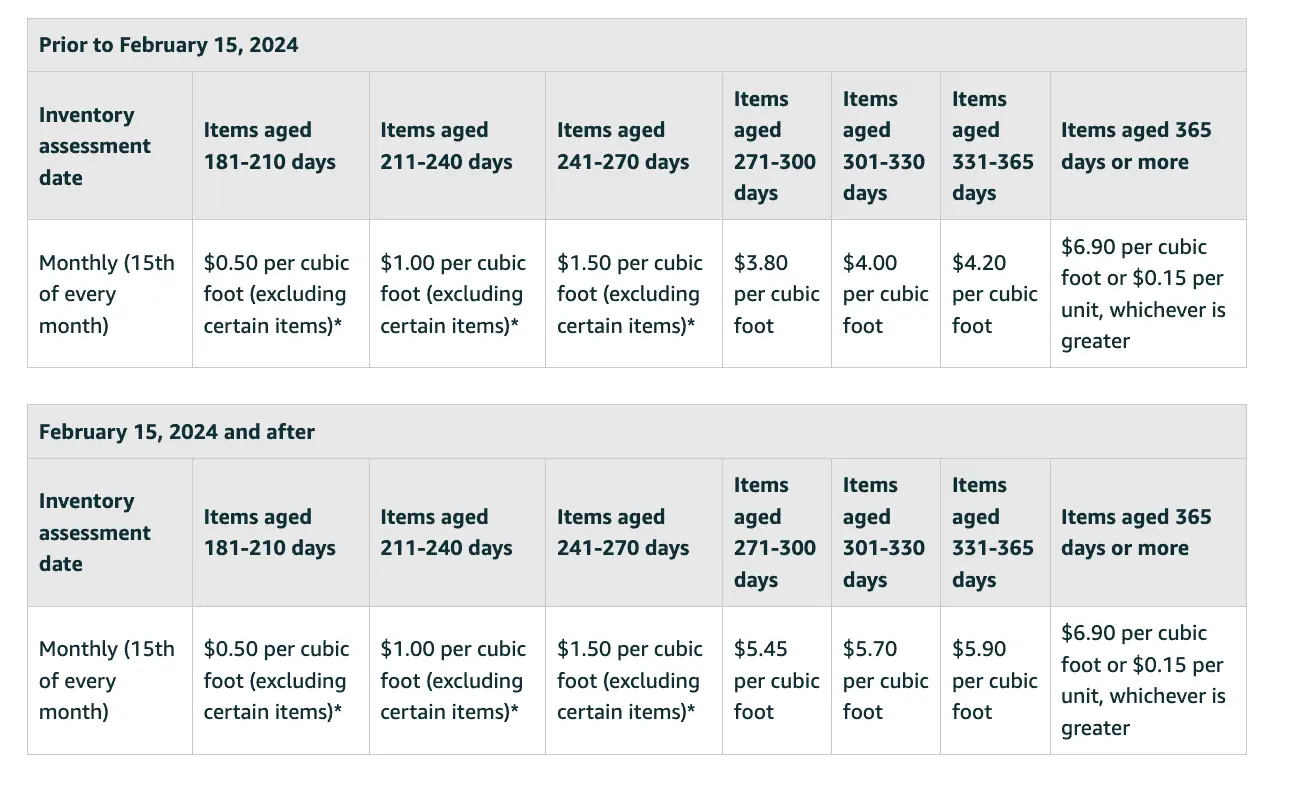
Long-term storage fees are where sellers get hit hardest. If your inventory sits in Amazon's warehouse for more than 271 days (about 9 months), you'll pay an additional surcharge on top of regular monthly storage fees. According to Practical Ecommerce, long-term storage fees can add $5.45-$6.90 per cubic foot depending on duration.
271-365 Days Storage
$5.45 per cubic foot (in addition to monthly storage fees)
Example: 100 cubic feet stored for 280 days = $5,450 long-term surcharge + regular monthly fees
365+ Days Storage
$6.90 per cubic foot (in addition to monthly storage fees)
Example: 100 cubic feet stored for 400 days = $6,900 long-term surcharge + regular monthly fees
Case Study: Kitchen Appliance Brand
A mid-sized kitchen appliance seller (anonymized for privacy) reduced storage fees from $21,000 to $7,800 monthly (63% reduction) by implementing 90-day inventory rotation. They tracked aging inventory in Nova's Products Feed, identified 47 SKUs sitting 250+ days, and created a liquidation plan. Result: $158,400 annual savings while maintaining 98% in-stock rate.
Storage Utilization Surcharge & IPI Score Impact
Beyond standard storage fees, Amazon charges a Storage Utilization Surcharge when your storage usage exceeds your allocated limit. This limit is based on your Inventory Performance Index (IPI) score. Industry research shows sellers with IPI scores below 500 face storage restrictions and fees that are 15-25% higher than sellers with healthy scores.
How IPI Score Affects Storage Costs
IPI Score 500+: Standard Capacity
Sellers maintaining IPI scores above 500 receive standard storage capacity with no restrictions. This is your target range for optimal warehouse utilization and cost control.
IPI Score 400-499: Limited Capacity
Reduced storage limits apply. You may face restrictions on shipment creation size and frequency. According toAmazon Seller Central, storage utilization surcharges of $10 per cubic foot can apply for excess inventory in this score range.
IPI Score Below 400: Severe Restrictions
Heavily restricted storage capacity. Overage fees reach $10+ per cubic foot. Amazon may limit your ability to send new inventory until you improve performance. This can cripple your business during peak season.
Did You Know?
According to industry research, approximately 23% of Amazon sellers operate with IPI scores below 500, meaning nearly 1 in 4 sellers pay elevated storage fees or face capacity restrictions. Improving your IPI score by just 50 points can unlock thousands in additional storage capacity.
6 Proven Strategies to Reduce FBA Storage Fees by 20-40%
Storage fees can represent 5-15% of total FBA costs. Here are actionable strategies that work for sellers doing $500K+ per month. For a complete breakdown of all FBA expenses, see our guide to reducing FBA fees.
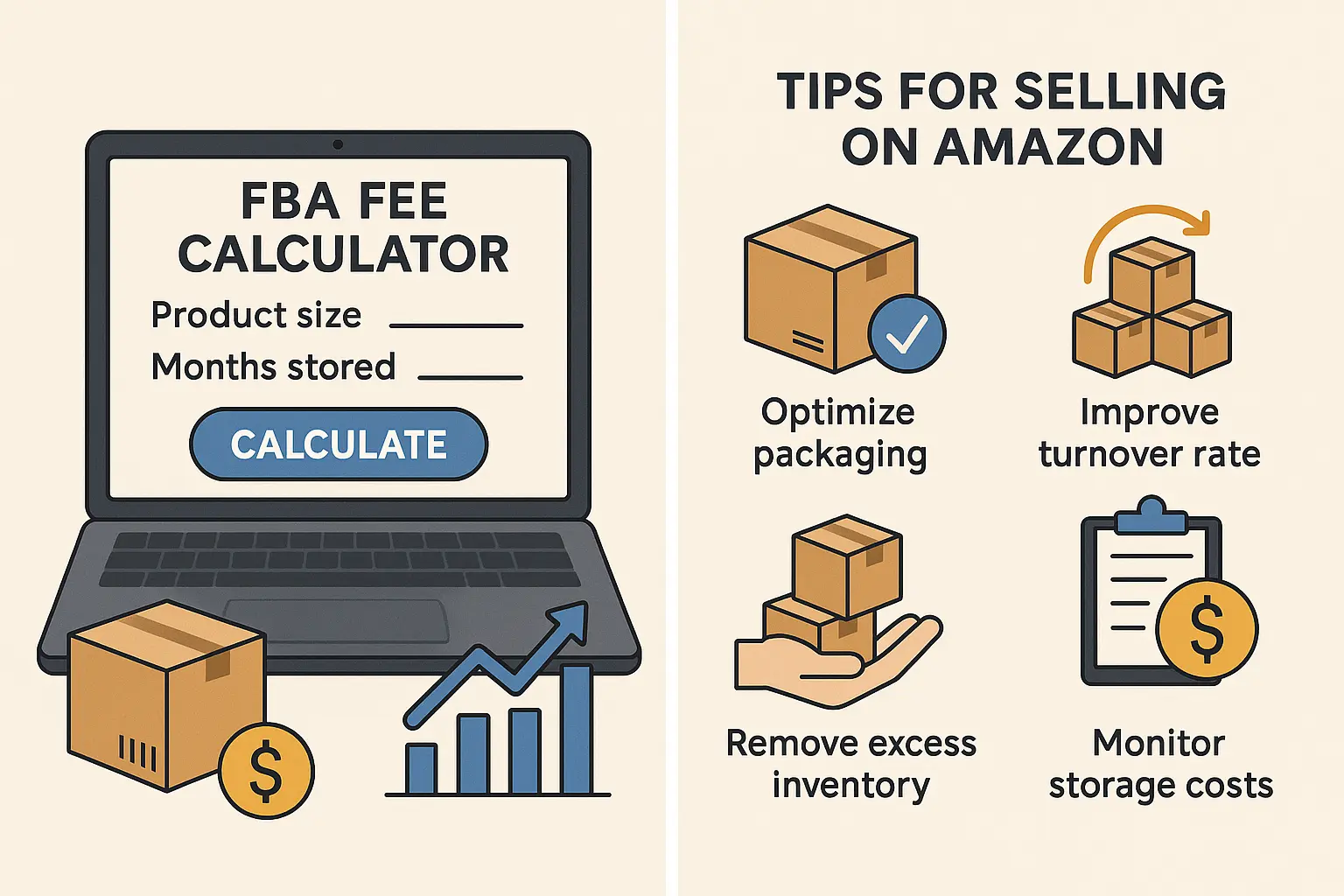
1track Product-Level Storage Costs Weekly
Most sellers only check storage fees when Amazon bills them monthly. That's too late. Track storage costs by SKU every week to identify problem inventory before it accumulates expensive charges.
Nova's P&L analytics automatically breaks down FBA storage fees by product, showing exactly which SKUs are draining your margins. You can filter by storage duration, identify aging inventory, and calculate the real profitability after storage costs.
Review storage reports weekly - Don't wait for monthly bills
Flag SKUs over 180 days - Before long-term fees hit at 271 days
Calculate true profit margins - Include storage costs in ROI calculations
Instead of sending 6 months of inventory at once, shift to smaller, more frequent shipments. JIT inventory reduces average storage time from 120+ days to 45-60 days. According to industry research, sellers using JIT strategies reduce storage fees by 35-50% on average.
Target 60-day supply - Balance storage costs with stockout risk
Use sales velocity data - Ship based on actual sell-through rates
Schedule shipments every 4-6 weeks - Maintain consistent flow
3run Liquidation Sales Before Day 271
Long-term storage fees kick in at 271 days. Create a systematic process to identify and liquidate slow-moving inventory before this deadline. Even selling at break-even is better than paying $5.45+ per cubic foot in long-term fees.
Use Nova's Winners & Losers dashboard to identify underperforming SKUs. Sort by storage days to see which products are approaching the 271-day threshold.
Set up 240-day alerts - Give yourself 30 days to liquidate
Run Lightning Deals - Amazon promotional tools can move inventory fast
Consider removal orders - Sometimes cheaper to remove and donate than pay long-term fees
4Optimize Packaging to Reduce Cubic Footage
Storage fees are charged by cubic feet, not by unit. Reducing package dimensions by even 10% can significantly lower your storage costs. Industry analysis from supply-chain publications has found that sellers who optimized packaging reduced storage costs by an average of 18%.
Use custom-sized boxes - Eliminate wasted space
Consider poly mailers - For soft goods, much smaller than boxes
Remove unnecessary packaging layers - Every inch counts
Calculate the ROI - Sometimes custom packaging pays for itself in 3 months
5Maintain IPI Score Above 500
Your Inventory Performance Index directly impacts storage capacity and fees. Amazon calculates IPI based on excess inventory, sell-through rate, stranded inventory, and in-stock rate. Keeping your score above 500 prevents storage restrictions and utilization surcharges. Use Nova's Custom Analytics to track your IPI score trends and receive alerts when you're at risk.
Key IPI factors to monitor:
Excess inventory percentage - Keep under 10% of total units
In-stock rate - Maintain 95%+ availability on best sellers
6Consider FBM for Slow-Moving Products
Not every product belongs in FBA. For slow-moving items (selling less than 10 units/month), Fulfillment by Merchant (FBM) can be more cost-effective. You'll save on monthly storage fees while maintaining Prime eligibility through Seller Fulfilled Prime. Use Nova's Custom Breakdowns to categorize products by fulfillment method and track profitability of each approach.
Compare the economics: A product sitting 6 months in FBA accumulates $150-250 in storage fees. With FBM, you store it yourself and only pay shipping when it sells. Learn more about FBA vs FBM cost comparisons.
Evaluate products selling under 10/month - Prime FBM candidates
Calculate break-even point - When does FBM become cheaper?
Use hybrid fulfillment - FBA for best sellers, FBM for slow movers
How Nova Helps You Cut Storage Costs
Nova's P&L dashboard automatically tracks FBA storage fees by SKU, showing exactly how storage impacts margins. You can:
View storage costs per product with hourly updates
Calculate true profit margins including all FBA fees
Tag and filter inventory by storage duration for faster decision-making
How to Calculate FBA Storage Fees: Step-by-Step Formula
Understanding the exact calculation helps you forecast costs accurately. Here's the formula Amazon uses. For detailed P&L tracking that automatically calculates all FBA fees including storage, see Nova's Profit & Loss Analytics tool.
Where Daily Average Volume = (Total cubic feet × Days stored) / Days in month
Calculation Example
Let's say you have a standard-size product with dimensions 12" × 10" × 8". According to DataFeedWatch's FBA cost breakdown, understanding this calculation is critical because storage fees compound monthly and can quickly erode profit margins if not monitored closely.
Step 1: Calculate Cubic Feet
12 × 10 × 8 = 960 cubic inches
960 ÷ 1,728 (cubic inches per cubic foot) = 0.556 cubic feet per unit
Use this example to project annual storage costs: 100 units at these dimensions would cost approximately $7,900/year in storage fees alone ($433.70 × 9 months + $1,334.40 × 3 months). That's before long-term fees if inventory doesn't sell. Always factor this into your product selection and sourcing decisions.
Many sellers don't track storage duration by SKU. They wake up to a $20,000 long-term storage fee bill and scramble to liquidate inventory. Set calendar reminders at 240 days to take action before long-term fees hit.
Mistake 2: Sending Inventory Without Demand Forecasting
Sending 6 months of inventory "just to be safe" is expensive. Use Nova's daily performance dashboard to track actual sales velocity. Send inventory based on data, not guesses.
Mistake 3: Not Accounting for Q4 Rate Increases
Storage fees roughly triple from October to December. Budget accordingly. A seller with 1,000 cubic feet of standard-size inventory pays an extra $1,620/month during Q4. That's $4,860 in additional fees for peak season alone.
Mistake 4: Letting IPI Score Drop Below 500
Low IPI scores trigger storage restrictions and utilization surcharges up to $10/cubic foot. Monitor your IPI weekly in Seller Central. Address stranded inventory and excess stock immediately to maintain 500+ scores.
Mistake 5: Not Optimizing Package Dimensions
Using oversized packaging wastes money. A product in a 10×10×10 box (578 cubic inches) costs significantly more than the same product in an 8×8×6 box (278 cubic inches). Audit your packaging and eliminate unnecessary space.
Common Questions About FBA Storage Fees
How much do Amazon FBA storage fees cost in 2026?
Standard-size items cost $0.78 per cubic foot per month (January-September) and $2.40 per cubic foot during peak season (October-December). Oversized items cost $0.56 per cubic foot (January-September) and $1.40 per cubic foot during peak season. These rates apply to monthly storage fees before any long-term storage surcharges.
What is the long-term storage fee threshold?
Amazon charges long-term storage fees when inventory has been stored for more than 271 days (approximately 9 months). The fee is $5.45 per cubic foot for items stored 271-365 days, and $6.90 per cubic foot for items stored over 365 days. These fees are charged in addition to regular monthly storage fees.
How do I calculate cubic feet for storage fees?
Calculate cubic feet by multiplying length × width × height (in inches), then dividing by 1,728 (the number of cubic inches in a cubic foot). Formula: (L × W × H) ÷ 1,728 = cubic feet. For example, a 12×10×8 inch box = 960 cubic inches ÷ 1,728 = 0.56 cubic feet. Use our free calculator above to estimate costs instantly.
Can I reduce FBA storage fees?
Yes. You can reduce storage fees by 20-40% through several strategies: implement just-in-time inventory replenishment to maintain 60-day supply instead of 120+ days, optimize packaging to reduce cubic footage, liquidate slow-moving inventory before 271 days, maintain IPI score above 500, and consider FBM for slow-moving products. Tools like Nova's FBA analytics platform help track storage costs by SKU and identify optimization opportunities.
What happens if my IPI score is below 500?
Sellers with IPI scores below 500 face storage capacity restrictions and additional Storage Utilization Surcharges ranging from $0.87 to $10.00 per cubic foot depending on usage. You may be unable to send new inventory during high-demand periods like Q4. To improve your IPI score, reduce excess inventory (keep under 10% of total units), improve sell-through rate (target 90+ days), fix stranded inventory immediately, and maintain 95%+ in-stock rate on best sellers.
When are FBA storage fees charged?
Monthly storage fees are assessed on the 15th of each month for inventory stored during the previous month. For example, fees for inventory stored in November are charged on December 15th. Long-term storage fees are assessed on the 15th of the month following the month when your inventory reached 271 days or 365+ days in storage. Amazon calculates fees based on daily average volume throughout the month.
Ready to Transform Your Amazon Business?
Join thousands of successful sellers who use Nova Analytics to make data-driven decisions and maximize their profits.

 Claude
 Gemini
 ChatGPT