
Back to Blog
FBA Guide
Featured
Updated Oct 8, 2026|Next review Jan 2027
Amazon FBA Storage Fees 2026
Every FBA storage fee explained: monthly rates, Q4 surcharges, aged inventory penalties, AWD comparison, and 5 strategies to cut costs by 25-40%.
Every FBA storage fee explained: monthly rates, Q4 surcharges, aged inventory penalties, AWD comparison, and 5 strategies to cut costs by 25-40%.
Mar 11, 2026 · 16 min · 4,200 words
Storage costs vary through the year because the rate you pay in February is not the rate you pay in November. Amazon's published base rate for standard size roughly triples from October to December, so a yearly average hides most of the real cost. If you store products in Amazon's warehouses, you pay for every cubic foot of space, every single day.
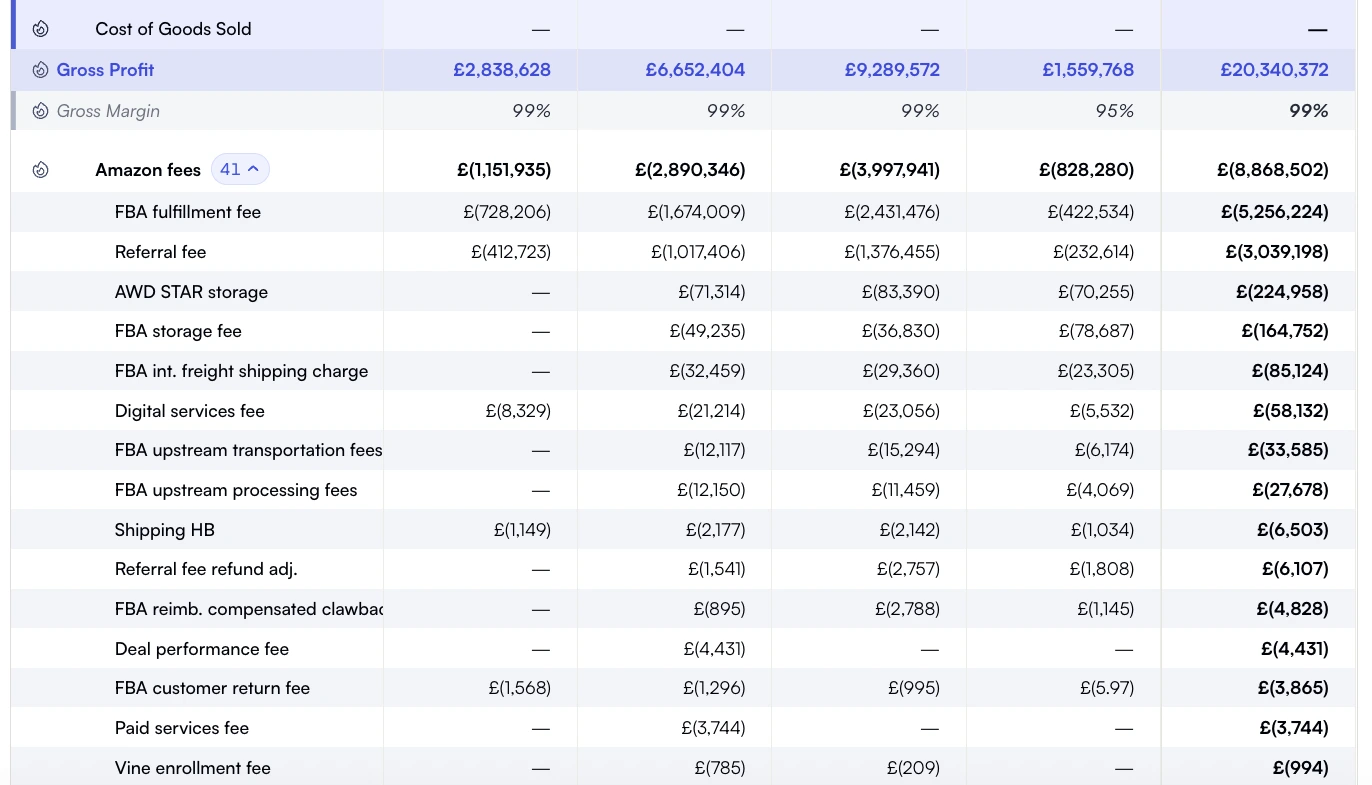
This guide breaks down every storage fee Amazon charges in 2026: monthly rates by size tier, seasonal surcharges, aged inventory penalties, and the new AWD (Amazon Warehousing and Distribution) cost structure. You'll learn exactly when each fee kicks in, how your IPI score affects your storage limits, and the five strategies sellers use to cut storage costs by 25-40%.
FBA storage fees are charged per cubic foot per month, with rates that increase 30%+ during Q4 (Oct-Dec). Long-term surcharges hit after 271 days. The most effective lever is Days of Inventory (DOI): keeping 30-60 days of stock instead of 90+ cuts storage costs dramatically while maintaining sell-through rates.
Amazon calculates storage fees based on the daily average volume your inventory occupies in fulfillment centers. According to Amazon's official fee schedule, fees are assessed on the 15th of each month for inventory stored during the previous month.
The formula is straightforward: (Average daily units × Unit volume in cubic feet) × Applicable rate per cubic foot. But the "applicable rate" changes based on three factors: product size tier, time of year, and how long inventory has been sitting.
$0.78
Per cubic foot/month
$2.40
Per cubic foot/month
+208%
October-December surge
Don't send excess inventory to FBA in September. Q4 rates kick in October 1st. If you're not confident it'll sell by December, store it in a 3PL or AWD facility and transfer in smaller batches. A seller moving 2,000 units of excess stock out before October saves roughly $1,200 in storage fees alone. Deciding what to move needs cover per SKU, which is what FBA inventory management software is for.
Amazon uses two size tiers for storage fee calculations: Standard-size (items under 20 lbs, fitting within 18" × 14" × 8") and Oversized (everything else). The rates below reflect the 2026 fee schedule published by Amazon Seller Central.
| Size Tier | Jan-Sep | Oct-Dec | Q4 Increase |
|---|---|---|---|
| Standard-Size | $0.78 / cu ft | $2.40 / cu ft | +208% |
| Oversized | $0.56 / cu ft | $1.40 / cu ft | +150% |
Consider a standard-size product that measures 12" × 8" × 4" (0.22 cubic feet per unit). Here's what storing 1,000 units costs across different months:
| Scenario | Units | Volume | Monthly Cost |
|---|---|---|---|
| January (non-peak) | 1,000 | 222 cu ft | $173 |
| November (peak) | 1,000 | 222 cu ft | $533 |
| Q4 with 3,000 units | 3,000 | 667 cu ft | $1,600 |
The Q4 rate change catches first-year sellers off guard because most fee calculators default to non-peak rates. Check which months a calculator is using before you trust its annual figure.
Monthly storage fees are just the baseline. Amazon also charges aged inventory surcharges on units sitting in FBA warehouses beyond certain thresholds. These surcharges are assessed on the 15th of each month in addition to regular storage fees.
| Inventory Age | Standard-Size | Oversized | Risk Level |
|---|---|---|---|
| 0-180 days | No surcharge | No surcharge | Low |
| 181-210 days | No surcharge | No surcharge | Watch |
| 211-270 days | No surcharge | No surcharge | Watch |
| 271-365 days | $1.50 / cu ft | $1.50 / cu ft | High |
| 365+ days | $6.90 / cu ft or $0.15/unit | $6.90 / cu ft or $0.15/unit | Critical |
The jump from zero surcharge to $1.50/cu ft at 271 days is sudden. A seller with 500 standard-size units (0.22 cu ft each) that crosses this threshold pays an extra $165/month on top of regular storage fees. That's $1,980/year for inventory that isn't moving. Track your Days of Inventory (DOI) to catch slow movers before they hit aged thresholds.
In Seller Central, navigate to Inventory > Inventory Health. This report shows the age distribution of your FBA inventory. Look specifically at the "Estimated Aged Inventory Surcharge" column. Amazon provides a 14-day grace period after the surcharge assessment date to create removal orders.
Most sellers check this report monthly. That's too late. If you're running more than 200 SKUs, you need automated monitoring. Nova's FBA Inventory module color-codes every SKU by DOI threshold so you can spot at-risk inventory before surcharges hit.
Your Inventory Performance Index (IPI) score affects how much you can send in and how much you end up storing. Amazon calculates IPI on a rolling basis, scoring sellers from 0 to 1,000, with a published threshold of 500. Accounts below it can face tighter FBA capacity limits, which forces awkward restock decisions right when you need headroom.
550+
Comfortable headroom
500-549
Above threshold, worth watching
<500
Tighter FBA capacity limits
IPI is influenced by four factors: excess inventory percentage, sell-through rate, stranded inventory, and in-stock rate. The first two carry the most weight. If you're holding 90+ days of stock for slow-moving ASINs, your IPI drops. If you frequently stock out on best sellers, it also drops.
For a deeper dive into IPI optimization strategies, including the specific levers that move your score fastest, read our complete IPI score guide.
Amazon Warehousing and Distribution (AWD) launched as Amazon's upstream storage solution. It stores bulk inventory at lower rates and automatically replenishes your FBA stock. For sellers with high-volume, predictable demand, AWD can cut storage costs significantly.
| Factor | FBA Storage | AWD |
|---|---|---|
| Non-Peak Rate | $0.78 / cu ft | $0.56 / cu ft |
| Peak Rate (Q4) | $2.40 / cu ft | $0.56 / cu ft (no surge) |
| Long-Term Surcharges | Yes, after 271 days | No surcharges |
| Auto-Replenishment | Manual shipments | Automatic to FBA |
| Minimum Quantity | No minimum | Full pallets preferred |
| Best For | Fast-moving, low-volume | High-volume, predictable demand |
A home goods seller storing 5,000 standard-size units (0.3 cu ft each) through Q4 saved $2,760 by moving 3,000 units to AWD. FBA cost for those units during Oct-Dec: $3,600. AWD cost for the same period: $840. The trade-off? Slightly longer replenishment lead times (2-5 days) and less control over when units arrive at FBA centers.
AWD makes sense when your inventory turnover is predictable and you're shipping pallet quantities. It doesn't make sense for new products where demand is uncertain, low-volume SKUs, or items that need frequent relabeling. For most sellers doing $50K+/month, a hybrid strategy works best: keep 30-45 days of fast movers in FBA, bulk stock in AWD.
Storage fee reduction isn't about sending less inventory to FBA. It's about sending the right amount at the right time. Here are the strategies that consistently deliver the biggest savings.
The single most impactful change you can make is reducing your average DOI from 90+ days to 30-60 days. This requires accurate demand forecasting and shorter replenishment cycles, but the storage savings compound every month.
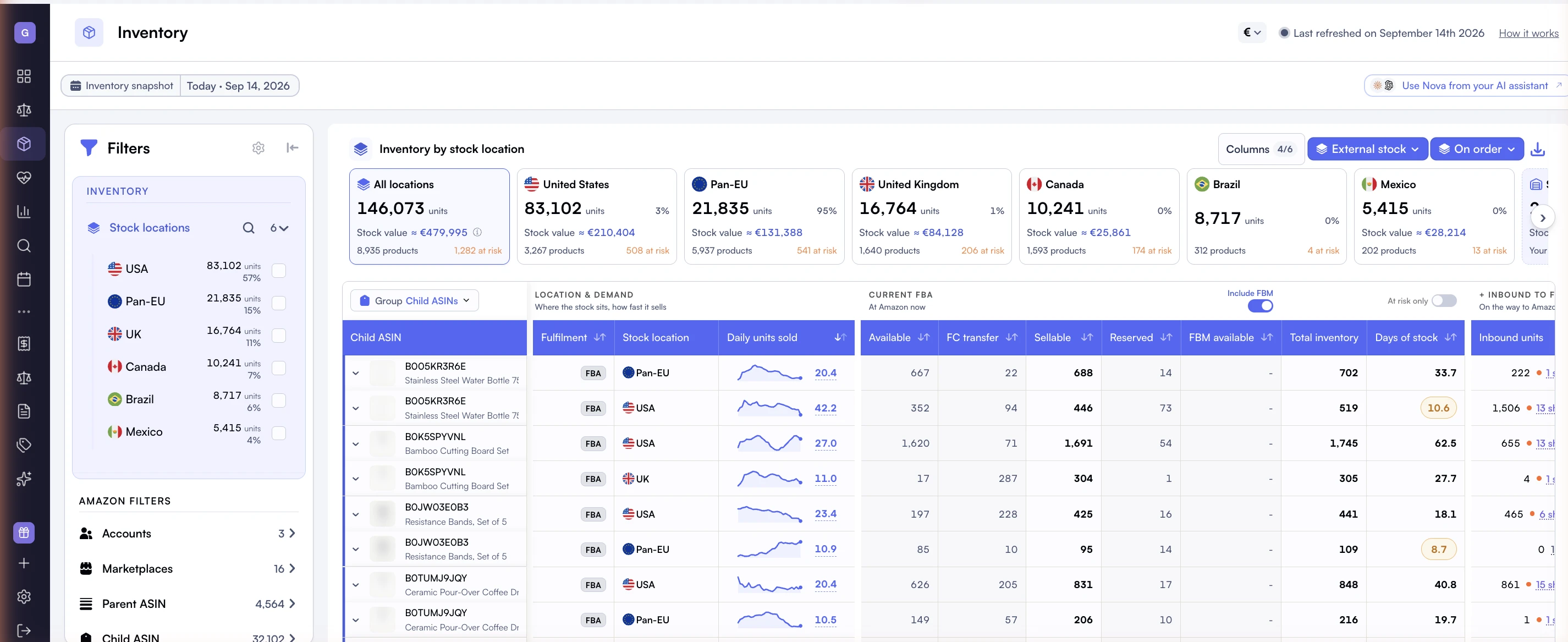
Days of Inventory (DOI) is calculated as: (Current FBA units ÷ Average daily sales) = Days of supply. Nova's inventory module color-codes DOI by ASIN so you can immediately spot which products are overstocked (red, 60+ days) vs. At risk (amber, under 14 days).
A 45-day cover is the usual compromise between storage cost and stockout risk, and eComEngine's inventory management guidance makes the same trade-off case. Go much below 30 days and lead-time variance starts causing stockouts. Go above 60 and you pay storage for protection you rarely use.
Set calendar reminders at 200 days for every slow-moving ASIN. At that point, you have 71 days to either run a promotion, adjust pricing, or create a removal order. Removal fees ($1.04-$1.53 per unit) are almost always cheaper than paying aged surcharges for months.
Storage fees are based on cubic feet. Reducing your product packaging by even 1 inch in each dimension can save 10-20% on storage costs across your entire catalog. Amazon measures dimensions based on the fully packaged unit, including poly bags and prep materials. Audit your top 20 ASINs for packaging efficiency.
Instead of creating removal orders for slow-moving inventory, sell it through other channels using Amazon's Multi-Channel Fulfillment. List aged FBA inventory on eBay, Walmart, or your own Shopify store at a discount. You clear the stock, avoid surcharges, and recover some margin instead of paying disposal fees.
Keep a 30-45 day supply in FBA for fast fulfillment. Store the rest in AWD or a third-party logistics (3PL) provider where monthly rates run $0.20-$0.45 per cubic foot. Replenish FBA weekly based on sell-through velocity. This hybrid approach is standard for sellers doing $100K+/month.
Nova's FBA inventory tracker shows DOI, demand velocity, and pipeline projections for every ASIN. Color-coded indicators flag units approaching aged surcharge thresholds so you can act before fees hit. Pair it with the full Amazon inventory management software view to see storage fees and aging inventory inside real-time P&L tracking.
October through December is when storage fees hurt most. Peak rates for standard-size items are roughly triple the off-peak rate. If you are also stocking up for holiday demand, you get higher rates and higher volume at the same time. Here's the Q4 playbook:
The biggest Q4 storage mistake? Sending 90 days of inventory in October for a product that only sells 20 units/day. That's 1,800 units occupying space at $2.40/cu ft when you only needed 600 units (30-day supply). Use your weekly business review to track inventory velocity and adjust restock volumes through the holiday season.
Storage fees typically represent 3-8% of total FBA costs for well-managed accounts. But for sellers with slow-moving inventory or poor IPI scores, they can balloon to 15-20%. Here's how they compare:
8-15%
Largest FBA cost component
$3-$8
Per unit shipped
3-8%
Of total FBA costs (managed)
While storage fees aren't the largest line item, they're the most controllable. Referral fees are fixed by category. Fulfillment fees are set by Amazon based on size and weight. But storage fees depend entirely on how much inventory you hold and for how long. That's why tracking DOI and IPI score is so critical to your profit margins.
For a full breakdown of every FBA fee and how they impact your bottom line, see our 2026 FBA fee changes guide and use our interactive storage fees calculator to model your specific costs.
How IPI is calculated, score thresholds, and the fastest strategies to improve it.
The metric that prevents stockouts and reduces storage fees simultaneously.
Cash flow strategies, demand forecasting, and reorder systems for FBA sellers.
$1 to cutting fulfillment, referral, and storage fees.
Join thousands of successful sellers who use Nova Analytics to make data-driven decisions and maximize their profits.
Explore more expert insights to grow your Amazon business
2026 FBA storage fee rates, monthly cost calculator, and long-term storage penalty thresholds. Plus 5 strategies that save sellers $5K-$20K per year. IPI score guide included.
Your IPI score controls how much you can store in FBA. Learn the 4 factors, current thresholds, and 7 strategies to improve your score fast.
Capacity Manager explained: how limits are calculated, bidding for additional space, and 6 strategies to maximize your FBA storage allocation.