
Amazon FBA fee changes 2026: every new rate, table by table
Every 2026 FBA fee change in one place: fulfillment rates, storage costs, inbound placement fees. Side-by-side comparison with 2025 rates so you see exactly what changed.
 Claude
 Gemini
 ChatGPT
Going into Q4 2026, the FBA fee stack is the most layered it has ever been. The January rate changes are live across every U.S. fulfillment center, a 3.5% fuel and logistics-related surcharge sits on top of every fulfilment fee, and the low-inventory-level fee is now judged on each variation separately. If you priced your catalog against 2025 assumptions, you are leaking margin on every unit shipped this quarter.
This guide breaks down every active FBA fee category, dated against Amazon's own pages, and shows what sellers connected to Nova actually paid once the changes landed. Track every fee line per SKU inside Nova's FBA analytics.
What changed in Amazon FBA fees in 2026?
Non-peak fulfilment fees rose on 15 January, by $0.08 per unit on average for standard-size products priced $10 to $50. A 3.5% fuel and logistics-related surcharge joined FBA fulfilment fees in the US and Canada on 17 April, and Buy with Prime and Multi-Channel Fulfillment on 2 May, with no published end date. The low-inventory-level fee is now measured per seller FNSKU rather than per parent ASIN, with the 28-day threshold unchanged. Holiday peak fulfilment fees run from 15 October 2026 to 14 January 2027 (Amazon Seller Central, 2026 US FBA fulfillment fee changes, checked 16 September 2026). Measured on Amazon accounts connected to Nova, the median seller paid 3.6% more per unit in FBA fulfilment fees than a year earlier.
- FBA fulfilment fee per unit, median change year over year
- 3.6%
- Sellers paying more per unit than a year earlier
- 77.6%
- Sellers who raised their average selling price
- 61.6%
- Sellers whose fees rose and price did not
- 1 in 4
February to August 2026 versus the same months of 2025. Source: Nova connected-seller data, methodology
What shipped when the 2026 rates went live
Four documented changes, each read from Amazon's own pages on 16 September 2026:
- Non-peak fulfilment fees rose on 15 January. Standard-size products priced $10 to $50 went up $0.08 per unit on average, those under $10 by $0.05, those above $50 by $0.31.
- A 3.5% fuel and logistics-related surcharge applies to FBA fulfilment fees in the US and Canada from 17 April, and to Buy with Prime and Multi-Channel Fulfillment from 2 May. It is not included in the published rate cards, and it does not touch referral fees.
- The low-inventory-level fee moved to seller FNSKU measurement on 15 January. The threshold is still 28 days of supply, but each variation is now judged on its own stock rather than the parent ASIN's.
- Holiday peak fulfilment fees run from 15 October 2026 to 14 January 2027, with the surcharge applying on top.
Complete FBA fee structure (active in 2026)
Amazon charges FBA fees in several categories. Here is what is active across your account today:
Fulfillment Fees
Charged per unit when Amazon picks, packs, and ships your order. Based on product size tier and weight.
Storage Fees
Charged monthly for space your inventory occupies in Amazon fulfillment centers. Rates increase during Q4.
Inbound Placement Fees
Charged when Amazon distributes your shipment across multiple fulfillment centers. Still avoidable in 2026 via the Partnered Carrier Program or AWD.
Low-Inventory-Level Fees
Charged per unit shipped when a product's historical days of supply is below 28 days in both the last 30 and the last 90 days, measured per seller FNSKU since January 2026.
What FBA Fees Don't Include
FBA fees are ON TOP of Amazon's referral fees (8-15% of sale price depending on category) and variable closing fees (if applicable). For complete cost calculation, see our Amazon FBA Calculator.
1. FBA Fulfillment Fees: Complete Breakdown
Fulfillment fees are charged every time Amazon ships a unit to a customer. Fees depend on size tier and weight of your product.
Amazon's published increase for 15 January 2026 was $0.08 per unit on average for standard-size products priced $10 to $50, $0.05 for those under $10 and $0.31 for those above $50, with the 3.5% fuel and logistics-related surcharge added on top from 17 April and excluded from the rate cards below (Amazon Seller Central, 2026 US FBA fulfillment fee changes, checked 16 September 2026). That is the published rate. Here is what sellers actually paid.
3.6%
The median seller paid 3.6% more in FBA fulfilment fees per unit on amazon.com in February to August 2026 than the same seller paid a year earlier, measured on several hundred Amazon sellers connected to Nova.
Amazon published a rate increase of roughly 4% for standard sizes. What sellers actually paid, across their whole catalogue, rose 3.6%.
February to August 2026 versus the same months of 2025. Source: Nova connected-seller data, methodology. This figure on the statistics hub
77.6%
More than three quarters of sellers paid more per unit in FBA fulfilment fees in February to August 2026 than a year earlier, measured on several hundred Amazon sellers connected to Nova.
The increase was close to universal. A seller whose fee per unit did not rise was almost certainly changing what they ship, not escaping the rate card.
February to August 2026 versus the same months of 2025. Source: Nova connected-seller data, methodology. This figure on the statistics hub
Size Tiers Explained
Amazon categorizes products into size tiers based on dimensions and shipping weight. Rates below exclude the 3.5% surcharge (Amazon Seller Central, 2026 US FBA fulfillment fee changes, checked 16 September 2026):
Small Standard-Size
Max 15" x 12" x 0.75", up to 12 oz
$3.06
$3.22
Large Standard-Size
Max 18" x 14" x 8", up to 20 lbs
$3.86
$4.08
$4.28
$4.65
$5.50
$6.10
$6.39
$6.75
+ $0.16 per half-pound above 3 lbs (up to 20 lbs)
Large Bulky (21-50 lbs)
Max 59" longest side, 130" perimeter, 50 lbs
$9.73 + $0.42/lb above 2 lbs
Example: 30 lb item = $9.73 + ($0.42 × 28) = $21.49
Extra-Large (51-70 lbs)
Over 50 lbs up to 70 lbs
$25.21 + $0.42/lb above 51 lbs
Example: 65 lb item = $25.21 + ($0.42 × 14) = $31.09
Special Oversize (70+ lbs)
Over 70 lbs or over 108" longest side
$137.32 + $0.79/lb above 90 lbs
Example: 120 lb item = $137.32 + ($0.79 × 30) = $161.02
4.4% vs 1.5%
Sellers whose units averaged under USD 4.00 to fulfil saw fees per unit rise 4.4%, while sellers averaging over USD 6.00 saw 1.5%, measured on several hundred Amazon sellers connected to Nova over February to August 2026 versus the same months of 2025.
In percentage terms the 2026 increase fell hardest on small, low-priced units. Cheap and light is where the change bites, not heavy and bulky.
February to August 2026 versus the same months of 2025. Source: Nova connected-seller data, methodology. This figure on the statistics hub
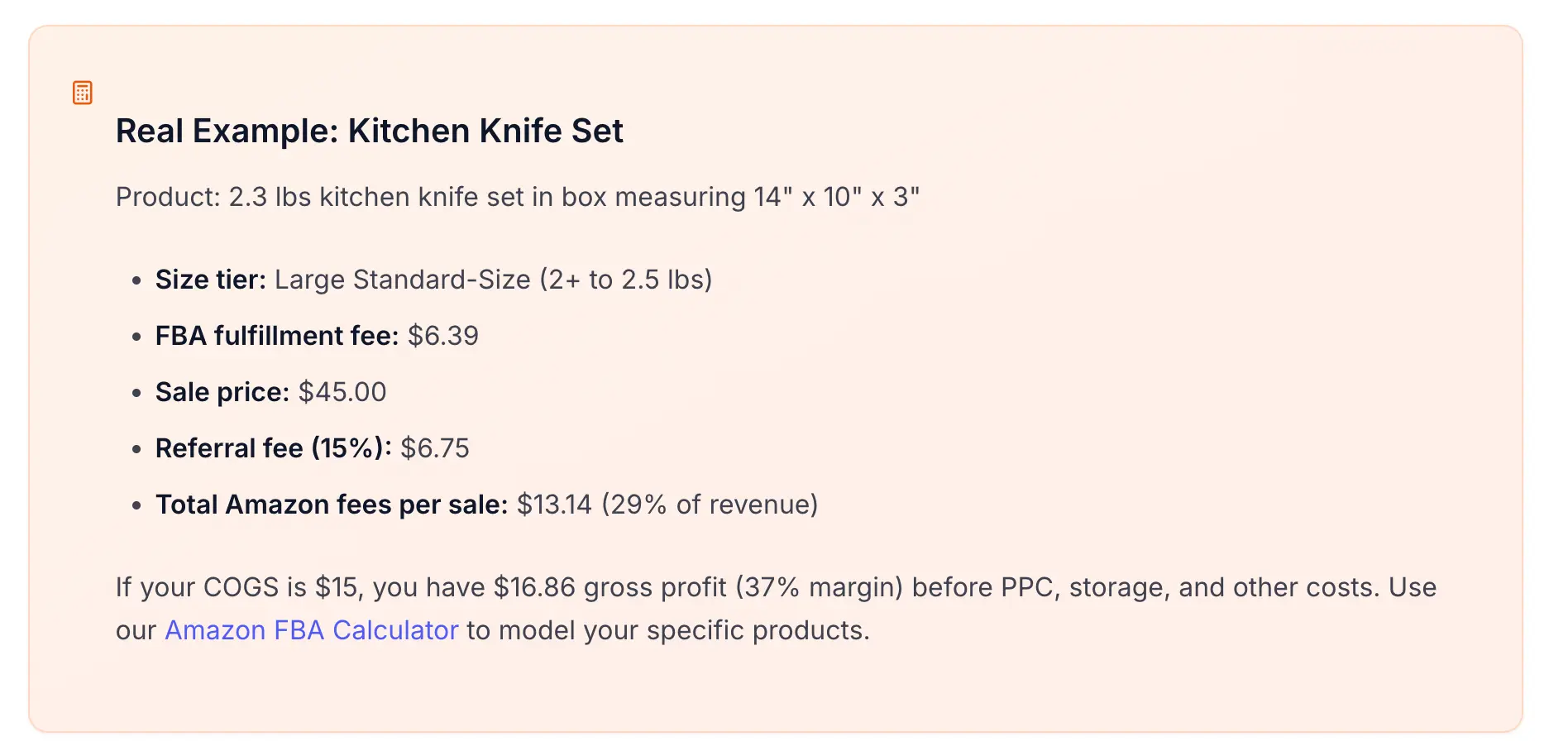
Example calculation: Large Standard-Size product (2.3 lbs) with complete fee breakdown and profit margin analysis
Ready to Transform Your Amazon Business?
Join thousands of successful sellers who use Nova Analytics to make data-driven decisions and maximize their profits.
2025 vs 2026 FBA Fee Changes: What's Different
Amazon's October 15, 2025 announcement included several fee adjustments for 2026. Here's the complete side-by-side comparison and what it means for your business.
| Fee Category | 2025 Rate | 2026 Rate | Change |
|---|---|---|---|
Small Standard (4 oz or less) Fulfillment fee | $3.06 | $3.18 | +$0.12 (+4%) |
Large Standard (2-2.5 lbs) Most common tier | $6.39 | $6.63 | +$0.24 (+3.8%) |
Large Bulky (Base fee) 21-50 lbs | $9.73 + $0.42/lb | $10.15 + $0.43/lb | +$0.42 (+4.3%) |
Fuel and logistics-related surcharge Applied to fulfilment fees, not referral fees | None | 3.5% | From 17 April 2026 |
Low-inventory-level fee How days of supply are measured | Parent ASIN, below 28 days | Seller FNSKU, below 28 days | Each variation judged on its own stock |
Fulfilment rates read from Amazon Seller Central, 2026 US FBA fulfillment fee changes, checked 16 September 2026. Published rate cards exclude the 3.5% surcharge.
Fee Increases to Plan For
Fulfilment fees rose, then the surcharge landed
The January rate rise and the 3.5% surcharge from 17 April both sit on every unit Amazon ships. On a $6.39 fulfilment fee the surcharge alone is about $0.22 per unit.
Small, low-priced units took the largest percentage rise
Sellers whose units averaged under $4.00 to fulfil saw the steepest change. The figure above the rate cards shows the split.
Where you get some room back
Products under $10 rose least
Amazon holds a discount on standard-size products priced below $10, now $0.86 per unit on average against products at $10 or higher.
FNSKU measurement cuts both ways
A single fast variation no longer drags a whole parent ASIN into the low-inventory-level fee, but a weak variation can no longer hide behind healthy siblings.
2. FBA Storage Fees: Monthly & Long-Term
Storage fees are charged monthly based on the volume (cubic feet) your products occupy in Amazon fulfillment centers. Rates vary by time of year and how long inventory has been stored.
Monthly Storage Fee Rates (2026)
January - September
Base rate (off-peak)
Amazon Seller Central, Monthly inventory storage fees, checked 16 September 2026.
October - December
Q4 peak season base rate
Amazon Seller Central, Monthly inventory storage fees, checked 16 September 2026.
The storage utilisation surcharge
Sellers whose storage utilisation ratio passes 22 weeks, and who shipped their first unit to a US fulfilment centre more than 365 days ago, pay a storage utilisation surcharge on top of the base rate, charged on inventory aged above 30 days. It runs from $0.44 per cubic foot at 22 to 28 weeks up to $1.88 at 52 weeks and over for standard size (Amazon Seller Central, Monthly inventory storage fees, checked 16 September 2026).
Aged Inventory Surcharges
Units that sit in fulfilment centres past 180 days pay an aged inventory surcharge each month, on top of the monthly storage fee, and the rate escalates with every age band. Amazon's rate card for the surcharge sits behind a Seller Central sign-in, so no band rate is quoted here. Read it in your own account, where it applies to your size tiers (Amazon Seller Central, Aged inventory surcharge, checked 16 September 2026, sign-in required).
The operating rule does not need the rate card: units approaching 180 days are the ones to discount, bundle or remove, because every band after that is more expensive than the one before it.
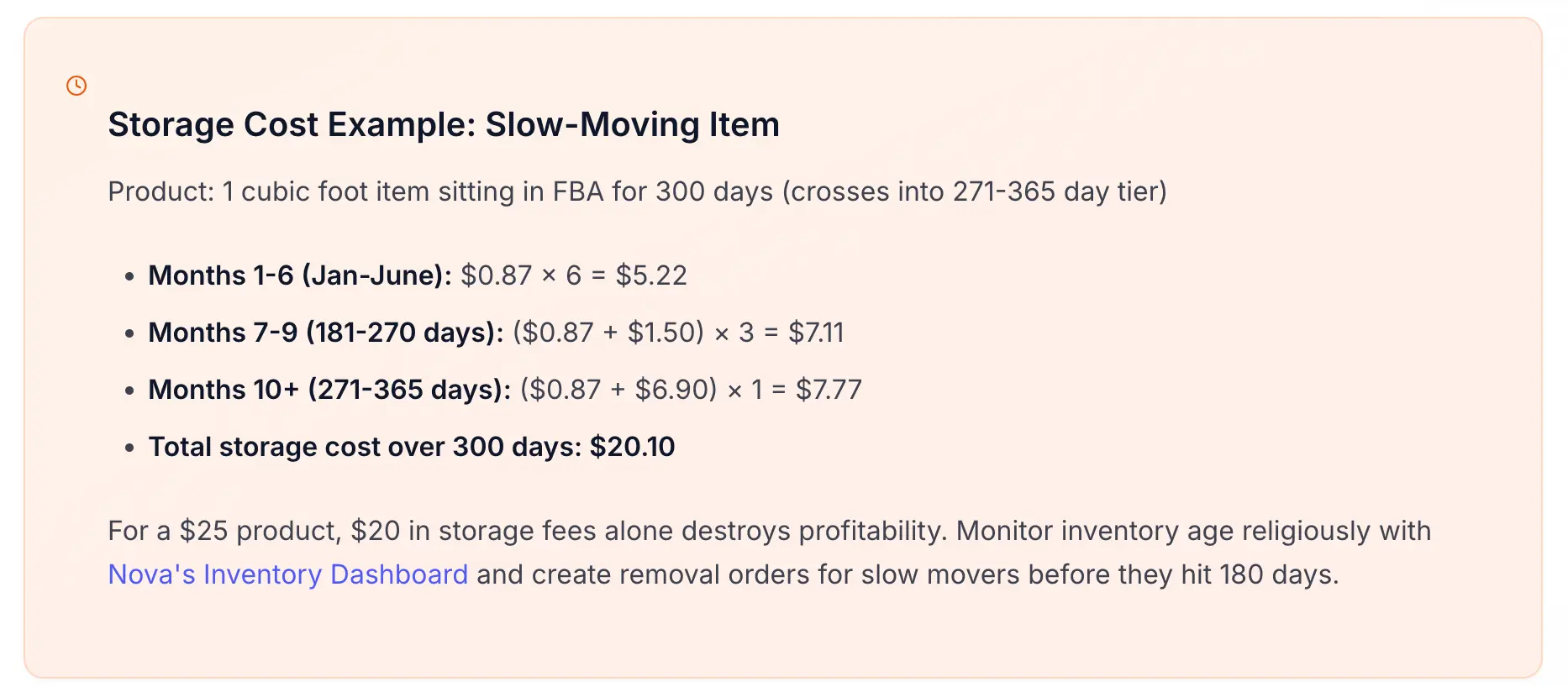
Storage cost escalation: How aged inventory fees accumulate and destroy profitability for slow-moving items
3. Inbound Placement Fees
Amazon introduced inbound placement fees in 2024 and they remain a standing cost line in 2026: a charge for distributing your shipment across multiple fulfillment centers to optimize delivery speed. Of every line in the fee stack, this is the one growing fastest in relative terms.
0.43%
Inbound placement fees took 0.43% of sales at the median seller in February to August 2026, up from 0.30% a year earlier, measured on several hundred Amazon sellers connected to Nova.
The fastest growing line in the fee stack, in relative terms. It is also the one a seller can most directly change, by shipping to more destinations.
February to August 2026 versus the same months of 2025. Source: Nova connected-seller data, methodology. This figure on the statistics hub
How Inbound Placement Fees Work
When you create a shipment plan, Amazon may split your inventory across 2-8 fulfillment centers nationwide. This incurs a per-unit placement fee based on size tier (Amazon Seller Central, FBA inbound placement service fee, checked 16 September 2026):
Small Standard-Size
Up to 12 oz
$0.27/unit
Large Standard-Size
Up to 20 lbs
$0.40/unit
Large Bulky
21-50 lbs
$1.28/unit
Extra-Large
51-70 lbs
$1.58/unit
How to Avoid/Minimize Inbound Placement Fees
Use Amazon's Partnered Carrier Program (PCP)
Amazon offers discounted UPS rates through their Partnered Carrier Program. When you use PCP, Amazon may waive or reduce placement fees. This is the #1 way most sellers avoid these fees entirely.
Use Amazon Warehouse Distribution (AWD)
AWD is Amazon's upstream bulk storage service. Ship large quantities to one AWD location, then Amazon automatically replenishes FBA fulfillment centers from there with no placement fees. Best for high-volume sellers (1,000+ units/month).
Choose "Minimal Shipment Splits"
In Seller Central shipment creation, select the "Minimal shipment splits" option. This may result in shipping to 1-2 fulfillment centers instead of many, reducing placement fees. However, you may pay slightly higher inbound shipping costs.
Cost Impact Example
Sending 1,000 units of a large standard-size item to FBA without using PCP: $0.40 × 1,000 = $400 in placement fees. Over a year with 12 shipments, that's $4,800 in avoidable costs. Always use Amazon's Partnered Carrier Program when possible.
Ready to Transform Your Amazon Business?
Join thousands of successful sellers who use Nova Analytics to make data-driven decisions and maximize their profits.
4. Low-Inventory-Level Fees
Amazon introduced low-inventory-level fees in 2024 to push sellers to hold adequate stock on fast-moving products. The threshold is 28 days of supply, and it did not change in 2026. What changed on 15 January 2026 is the level it is measured at: Amazon now calculates historical days of supply per seller FNSKU instead of per parent ASIN, so every variation is judged on its own stock (Amazon Seller Central, Low-inventory-level fee, checked 16 September 2026).
When Low-Inventory Fees Apply
Both windows have to be below 28 days
The fee applies only when the last 30 days and the last 90 days of historical days of supply are both under 28. Keep either window above 28 and the fee does not trigger.
Measured per seller FNSKU since 15 January 2026
A parent listing with a dozen variations is now a dozen separate fee exposures. A healthy parent no longer protects a thin child.
Charged on every unit shipped while under the threshold
The rate depends on size tier, shipping weight and how far under 28 days you are, and it is added to the FBA fulfilment fee for each shipped unit.
How to Avoid Low-Inventory-Level Fees
Implement Demand Forecasting
Track sales velocity and forecast future demand. For a product selling 150 units/month, you need 150 units in FBA to avoid fees (30-day supply). Build in buffer for lead time.
Use Nova's Inventory Management to track stock levels and days of inventory based on your specific sales velocity and lead times.
Set Aggressive Restock Points
Don't wait until you're at 28 days of stock. Restock when you hit 45-60 days, accounting for manufacturing lead time (15-30 days) + shipping to Amazon (7-14 days). Better to pay slightly more storage than get hit with low-inventory fees on every sale.
Monitor Seller Central Alerts
Amazon sends notifications when you're approaching low-inventory status. Act immediately - don't wait. Consider air freight for emergency restocks if land/sea shipment won't arrive in time.
Cost Impact Example
Your bestselling product sells 200 units/month. You run out of stock and it takes 21 days to restock. During those 21 days, you sell 140 units.
- Low-inventory fee: $0.95 per unit
- Units sold during low stock: 140
- Total penalty: $0.95 × 140 = $133
Plus, you likely lost Buy Box during the stockout, causing additional sales loss. Maintain healthy inventory levels - it's always cheaper than the alternative.
5. Other FBA Fees to Know
Returns Processing Fees
Charged when a customer returns an item in certain categories (apparel, watches, jewelry, shoes, handbags). Fee equals the fulfillment fee (e.g., $3.22 for small standard item). You don't get the original fulfillment fee back.
Removal Order Fees
When you request Amazon to return your inventory to you: $0.60-$1.40 per unit depending on size. Disposal fees (if you want Amazon to destroy inventory): $0.30-$0.90 per unit. Often cheaper to dispose than return oversized items.
Unplanned Service Fees
Charged when you don't properly prep items (missing labels, incorrect packaging, etc.): $0.40-$1.80 per unit. Amazon has to fix your mistakes. Always follow FBA prep requirements to avoid these penalties.
Label Service Fees
If you opt for Amazon to label your products instead of doing it yourself: $0.30 per unit. Saves time but adds up on high volumes. Consider buying your own label printer if shipping 500+ units/month.
Who paid for the 2026 increase
Fees per unit rose for more than three quarters of sellers, and most of them put the difference on the price. Six in ten raised their average selling price, by 2.7% at the median. Look only at fees as a share of sales and the year looks flat, median change minus 0.06 points, but that is prices rising alongside fees, not fees standing still. The sellers who matter here are the quarter whose fees rose and whose price did not. For them the increase came out of margin, unit by unit, with nothing in the fee share to show it.
61.6%
Six sellers in ten raised their average selling price between February to August 2025 and the same months of 2026, by 2.7% at the median, measured on several hundred Amazon sellers connected to Nova.
The fee increase was largely passed on. Median price per unit went from USD 26.98 to USD 29.41 while fees per unit rose 3.6%.
February to August 2026 versus the same months of 2025. Source: Nova connected-seller data, methodology. This figure on the statistics hub
1 in 4
One seller in four had fees per unit rise and did not raise price, measured on several hundred Amazon sellers connected to Nova over February to August 2026 versus the same months of 2025.
For these sellers the increase came straight out of margin. That is where the 2026 changes actually landed.
February to August 2026 versus the same months of 2025. Source: Nova connected-seller data, methodology. This figure on the statistics hub
7 Strategies to Reduce FBA Fees
Now that you understand the complete fee structure, here are actionable strategies to minimize costs:
1. Optimize Product Dimensions & Weight
Reducing product weight or dimensions by even small amounts can drop you into a lower fee tier. A product at 1.6 lbs pays more than one at 1.5 lbs.
- Work with suppliers to minimize packaging weight
- Use lighter materials (foam vs bubble wrap)
- Compact packaging - every inch counts toward cubic feet
Potential savings: $0.50-$2.00 per unit on fulfillment fees
2. Use Amazon's Partnered Carrier Program
Always ship to Amazon using their Partnered Carrier (UPS). You get:
- Discounted shipping rates (often 30-50% off retail UPS rates)
- Waived or reduced inbound placement fees
- Automatic tracking integration
Potential savings: $0.40/unit on placement fees + shipping discount
3. Maintain Optimal Inventory Levels
Strike the balance between stockouts (low-inventory fees) and overstocking (storage fees):
- Target 45-60 days of stock for fast movers
- Monitor IPI (Inventory Performance Index) score - stay above 450
- Monitor restock needs based on velocity
- Remove aged inventory before it hits 180 days
Use Nova's Inventory Management for inventory tracking and profitability analysis.
4. Q4 storage timing
The cheap January to September storage window ($0.78/cu ft standard) closes on October 1. Anything you do not want carried at peak rates has to move before then:
- January to September: $0.78/cu ft for standard, $0.56/cu ft for oversize. Cheapest storage window of the year.
- October to December: peak rates of $2.40/cu ft standard, $1.40/cu ft oversize (Amazon Seller Central FBA storage fees, checked 15 September 2026).
- Clear units approaching the 181-day aged-inventory band before Q4 hits.
- Pull-forward inbounds for Q4 hero SKUs while storage is still cheap.
Pre-peak move: Use the lower-cost window to position Q4 inventory and remove slow-movers, then lock the catalog before October.
5. Consider Hybrid FBA/FBM Strategy
Not every product needs FBA. Selectively use FBM for:
- Oversized/heavy items where FBA fees crush margins
- Slow-moving items (under 50 units/month)
- Products you also sell on other channels (Walmart, Shopify)
Learn more in our FBA vs FBM Complete Guide.
6. File FBA Reimbursement Claims
Amazon makes mistakes - lost inventory, damaged items, incorrect fees. You're entitled to reimbursement:
- Lost or damaged inventory in FBA warehouses
- Customer returns not credited back
- Overcharged fulfillment or storage fees
- Destroyed inventory errors
Average seller recovers $1,500-$3,000/year. Read our Complete Reimbursement Guide.
7. Use Multi-SKU Bundling Strategically
Bundling multiple small items into one SKU can reduce per-unit fulfillment costs:
- Example: Selling 3 small items separately = 3× $3.22 = $9.66 in fees
- Bundle them together = 1× $4.65 (if under 1.5 lbs total)
- Savings: $4.91 per order (51% reduction)
Test bundled variations with higher price points. Often increases AOV and reduces fulfillment cost percentage.
Q4 2026 fee-impact checklist
Three quarters into the new fee schedule, here is the four-step audit to run before the Q4 surcharges land:
Step 1. Re-baseline
Pull SKU-level fee totals for 2026 to date and compare to the same months of 2025. Quantify the actual hit per unit.
Step 2. Reorder logic
Confirm restock triggers run per variation, not per parent ASIN, and keep each one above the 28-day floor.
Step 3. Pricing
Re-test the 0.8-1.5% price moves you modeled in Q4 2025. If you held prices flat, your margin curve has drifted.
Step 4. Q4 staging
Clear aged inventory now while Jan-Sep storage is cheap. Position Q4 hero SKUs before October rates return.
Ready to Transform Your Amazon Business?
Join thousands of successful sellers who use Nova Analytics to make data-driven decisions and maximize their profits.
Track Your True Costs with Nova Analytics
See Your Real Profit After All FBA Fees
Understanding FBA fees is one thing - tracking them continuously across all your products is another. Nova Analytics automatically calculates your true profit after accounting for:
- All FBA fulfillment fees by SKU
- Monthly storage costs
- Referral fees
- PPC spend
- COGS and landed costs
- Returns and refunds
Key Takeaways
FBA Fulfillment Fees
- Charged per unit shipped ($3.22-$137+ depending on size/weight)
- Optimize product dimensions to drop into lower tiers
- Small standard items (<1 lb) most cost-effective
Storage Fees
- Base rate $0.78/cu ft (Jan-Sep), $2.40/cu ft (Oct-Dec), standard size
- Aged inventory (180+ days) incurs massive surcharges
- Remove slow movers before 180-day mark
Newer fee categories (still active in 2026)
- Inbound placement fees: Use Amazon Partnered Carrier to avoid
- Low-inventory fees: keep each variation above the 28-day threshold, measured per FNSKU
- Both can be completely avoided with proper planning
Cost Reduction Strategies
- Optimize packaging to reduce weight/dimensions
- Ship before October to avoid the peak storage rate, $2.40/cu ft against $0.78
- File reimbursement claims ($1,500-$3,000/year recovered)
FBA fees will consume 20-40% of your revenue depending on product type. The difference between profitable and unprofitable products often comes down to understanding and optimizing these costs. Use Nova's Amazon FBA Calculator to model your exact costs before launching new products, and P&L Dashboard to track ongoing profitability across your catalog.
Sources
Every Amazon rate on this page was read from an Amazon page on 16 September 2026. Where a rate sits behind a Seller Central sign-in, no number is quoted. Nova figures come from Amazon accounts connected to Nova and are documented in Nova's published methodology.
- Amazon Seller Central, 2026 US FBA fulfillment fee changes, checked on 16 September 2026.
- Amazon Seller Central, Monthly inventory storage fees, checked on 16 September 2026.
- Amazon Seller Central, Low-inventory-level fee, checked on 16 September 2026.
- Amazon Seller Central, Aged inventory surcharge, checked on 16 September 2026.
- Amazon Seller Central, FBA inbound placement service fee, checked on 16 September 2026.
Ready to Transform Your Amazon Business?
Join thousands of successful sellers who use Nova Analytics to make data-driven decisions and maximize their profits.
Amazon FBA fees in 2026: frequently asked questions
What changed when the January rates went live, and how to operate against the new schedule
Continue Learning
Explore more expert insights to grow your Amazon business
FBA vs FBM 2026: Complete Decision Guide for Amazon Sellers
Choosing between FBA and FBM impacts profit margins, operations, and scalability. Complete comparison with costs, benefits, and decision framework for 2026.
COGS Tracking for Amazon Sellers
Master COGS tracking for Amazon FBA: what to include, tracking methods, optimization strategies, and automation. Accurate cost tracking for better profitability.
Amazon FBA Reimbursement Guide 2026: Recover Lost Inventory
Recover $1,500-$3,000 annually in lost inventory and overcharged fees. Complete guide to Amazon FBA reimbursements with step-by-step filing process.