
FBA vs FBM 2026: Complete Decision Guide for Amazon Sellers
Choosing between FBA and FBM impacts profit margins, operations, and scalability. Complete comparison with costs, benefits, and decision framework for 2026.
 Claude
 Gemini
 ChatGPT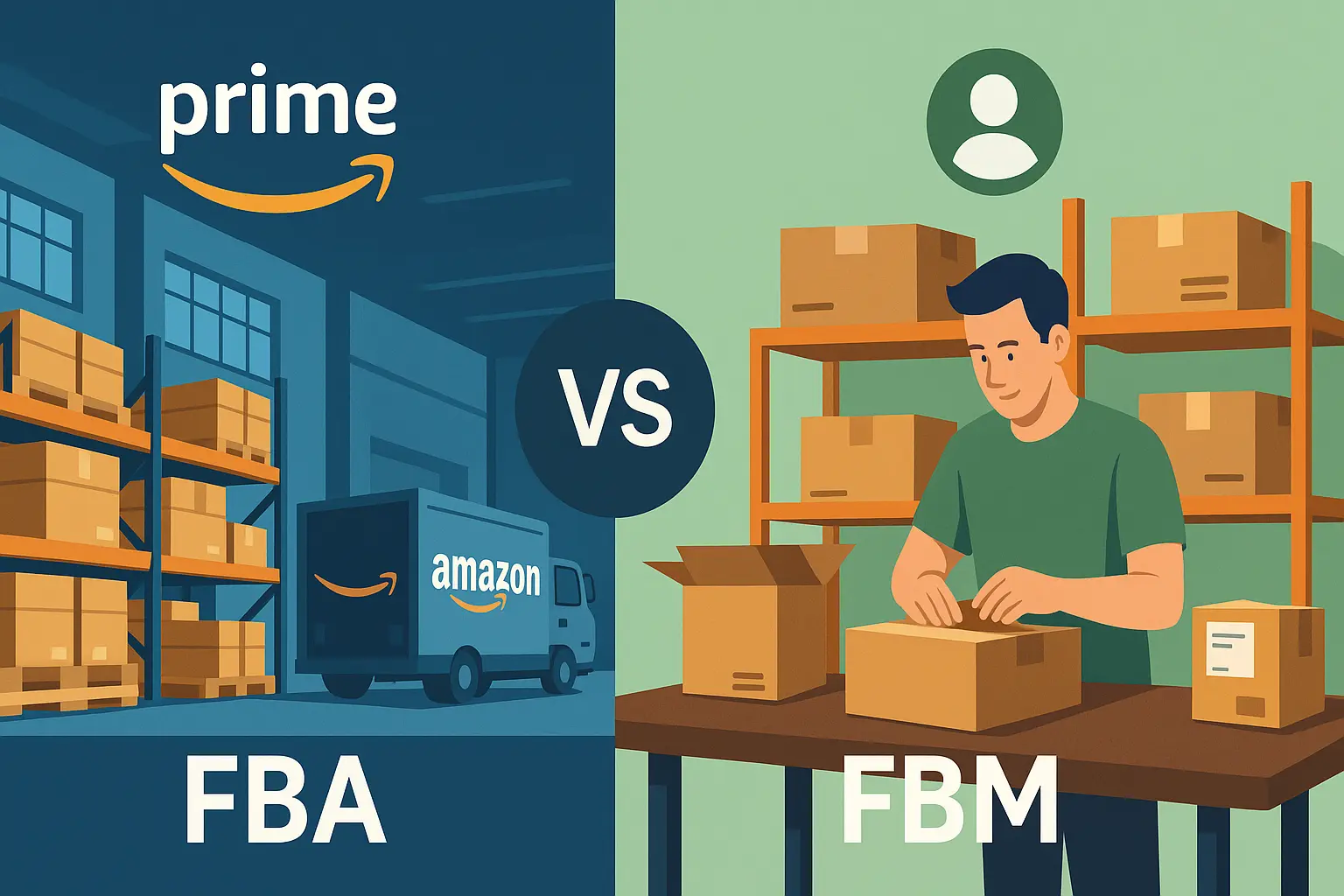
Choosing between Fulfillment by Amazon (FBA) and Fulfillment by Merchant (FBM) is one of the most consequential calls you make as an Amazon seller. Halfway through 2026, with the January 1 FBA fee schedule now live and Amazon's multi-channel fulfillment network expanding off-Amazon, the math behind this decision has shifted again. Margin, ops load, customer experience, and scale all hinge on getting it right per SKU, not for the whole catalog. Pulled from cockpit data across hundreds of accounts, not from a thought-leadership deck.
This guide provides a complete framework for making the right fulfillment decision for your specific situation. Whether you're launching your first product or managing a portfolio of 50+ SKUs generating seven figures annually, you'll find actionable insights backed by real data from thousands of sellers. If you already know your FBA path, you can also pre-check per-unit economics in our Amazon FBA profit & fee calculator.
FBA vs FBM: Key Differences at a Glance
Before diving into detailed comparisons, here's what separates these two fulfillment models at their core:
| Aspect | FBA (Fulfillment by Amazon) | FBM (Fulfillment by Merchant) |
|---|---|---|
| Who fulfills orders | Amazon handles everything | You handle everything |
| Prime eligibility | Automatic Prime badge | No Prime (unless SFP qualified) |
| Customer service | Amazon manages all inquiries | You manage all inquiries |
| Returns processing | Amazon handles returns | You handle returns |
| Storage location | Amazon fulfillment centers | Your warehouse or 3PL |
| Typical cost structure | Higher per-unit fees | Lower per-unit, higher fixed costs |
| Buy Box win rate | 25-30% higher on average | Lower without Prime badge |
According to Marketplace Pulse research, approximately 35% of high-volume Amazon sellers use a hybrid approach, using FBA for fast-moving items and FBM for products where the unit economics favor merchant fulfillment. The choice between FBA and FBM isn't binary for most successful operations. With 180 million U.S. Prime members in 2024, access to Prime eligibility through FBA remains a significant competitive advantage for many product categories.
Understanding FBA: How Amazon Fulfillment Works
Fulfillment by Amazon means Amazon stores your products in their fulfillment centers, picks and packs your orders when they sell, ships them to customers with their carrier network, and handles all post-purchase customer service and returns. You pay Amazon for these services through a combination of fulfillment fees, storage fees, and optional service fees.
The FBA Process Flow
Here's how the FBA process works from inventory shipment to customer delivery:
Create Shipment & Prepare Inventory
You create a shipment plan in Seller Central, print FBA labels for each unit, and prepare boxes according to Amazon's packaging requirements. Amazon assigns destination fulfillment centers based on their network optimization algorithms.
Ship to Amazon Fulfillment Centers
You ship inventory to one or more Amazon fulfillment centers. You can use Amazon's Partnered Carrier Program for discounted rates or arrange your own shipping. Inbound placement fees apply if Amazon distributes your shipment across multiple locations.
Amazon Receives & Stores Products
Amazon receives your inventory, scans barcodes, and stores products in their warehouses. Storage fees begin accruing immediately based on cubic foot volume. Products may be redistributed across Amazon's network for faster delivery to customers.
Customer Orders & Amazon Fulfills
When a customer orders, Amazon picks the product from the nearest fulfillment center, packs it in Amazon-branded packaging, and ships with 1-2 day Prime delivery. Fulfillment fees are charged per unit based on size and weight tier.
Post-Purchase Support & Returns
Amazon handles all customer service inquiries, processes returns according to their policies, and manages refunds. Returns are inspected and either returned to sellable inventory or designated as damaged/unsellable.
Complete FBA Cost Structure (2026)
Understanding every fee component is critical for accurate profit calculations. According to Practical E-commerce analysis, Amazon has increased fulfillment fees by over 30% since 2020, making precise cost tracking essential for profitability. Here's the complete breakdown for 2026:
1. Referral Fees (8-15% of sale price)
Charged on every sale regardless of fulfillment method. Most categories are 15%, but some like electronics are 8% and jewelry can be up to 20%. This is not an FBA-specific fee but must be included in total cost calculations.
See Amazon's 2025 FBA fulfillment fee schedule for category-specific rates and latest updates.
2. FBA Fulfillment Fees ($3.22-$137+ per unit)
Charged every time Amazon picks, packs, and ships your product. Fees are based on size tier and shipping weight. Small standard-size items under 1 lb cost $3.22, while large standard items (most common) range from $3.86 to $9+ depending on weight. For detailed fee tables, see Amazon's official FBA fulfillment fee page.
Example: 2 lb product
Large standard-size, 2 lbs = $6.10 fulfillment fee per unit
3. Monthly Storage Fees ($0.87-$2.40 per cubic foot)
Charged monthly based on daily average volume. Standard-size items cost $0.87/cu ft (January-September) or $2.40/cu ft (October-December). Aged inventory (271+ days old) incurs additional $6.90/cu ft surcharges. Calculate storage volume: Length × Width × Height (in inches) ÷ 1,728 = cubic feet.
4. Inbound Placement Fees ($0.27-$1.58 per unit)
New fee introduced in 2024-2025. Charged when Amazon distributes your shipment across multiple fulfillment centers to optimize their network. Fees vary by size tier. Can be reduced or eliminated by using Amazon's Partnered Carrier Program or AWD (Amazon Warehousing & Distribution).
5. Low-Inventory-Level Fees ($0.89-$1.10 per unit)
New fee introduced in 2025. Charged when your inventory falls below 28 days of forecasted demand for high-velocity products. Amazon calculates this automatically based on your sales velocity. Only applies to products selling more than 20 units per week.
Real-World FBA Cost Example
Kitchen gadget selling for $28.99, weighs 1.8 lbs, dimensions 10" × 6" × 4" (0.14 cu ft):
Your product cost, inbound shipping, and advertising spend must fit within $18.75 to remain profitable. Use our Profit & Loss Analytics to track actual margins.
Ready to Transform Your Amazon Business?
Join thousands of successful sellers who use Nova Analytics to make data-driven decisions and maximize their profits.
Understanding FBM: How Merchant Fulfillment Works
Fulfillment by Merchant means you (or your 3PL partner) handle all fulfillment operations: receiving and storing inventory, picking and packing orders, printing shipping labels, handing off packages to carriers, and managing all customer service and returns. Amazon only facilitates the sale and collects payment, charging you a referral fee (8-15% depending on category).
The FBM Process Flow
Here's the complete FBM fulfillment process from order notification to delivery:
Store Inventory at Your Location
You maintain inventory at your own warehouse, garage, or third-party logistics (3PL) facility. You're responsible for storage costs, insurance, inventory tracking systems, and security. No storage limits imposed by Amazon.
Receive Order Notification
When a customer orders, you receive notification via Seller Central, email, or API integration. Amazon expects you to confirm the order and ship within your promised handling time (typically 1-2 business days).
Pick, Pack & Ship Product
You pick the product from your inventory, pack it with appropriate materials, print a shipping label, and hand off to your chosen carrier (USPS, UPS, FedEx, etc.). You're responsible for selecting packaging that protects the product and meets carrier requirements.
Upload Tracking & Monitor Delivery
You must upload tracking information to Seller Central within your handling time. Amazon tracks on-time delivery and valid tracking rate as key performance metrics. Late shipments negatively impact your account health.
Handle Customer Service & Returns
You're responsible for responding to all customer inquiries within 24 hours, processing returns according to Amazon's policies, issuing refunds, and managing any order issues. Customer service performance directly affects your seller metrics.
Complete FBM Cost Structure
FBM has lower per-unit variable costs but requires investment in operational infrastructure:
1. Referral Fees (8-15% of sale price)
Same as FBA. Charged on every sale based on category. Most products are 15%. This is unavoidable whether you use FBA or FBM.
2. Shipping Costs ($3-$15+ per order)
Variable cost based on package weight, dimensions, destination zone, and carrier. USPS Priority Mail for a 1 lb package costs approximately $4-$8 depending on distance. Negotiated carrier rates can reduce costs by 15-30% at volume.
Use Pirate Ship's published rate cards or similar platforms for discounted carrier rates without minimum volume commitments.
3. Storage Costs ($1-$5 per cu ft/month)
If using self-storage: $50-$200/month for 200-1,000 sq ft. If using 3PL warehouse: typically $1-$5 per cubic foot per month depending on facility and location. No age-based surcharges like Amazon imposes.
4. Labor & Picking Costs ($1-$3 per order)
Self-fulfillment: your time cost. 3PL fulfillment: typically $1.50-$3.00 per pick + $0.50-$1.00 per pack. Multi-item orders cost more. Factor in training time, error rates, and overhead.
5. Packaging Materials ($0.50-$2 per order)
Boxes, bubble wrap, tape, labels, branding inserts. Can buy in bulk to reduce per-unit costs. Damaged goods from poor packaging eat into margins quickly.
6. Software & Systems ($50-$500/month)
Inventory management software, shipping label platforms, order management systems. Can be minimal (free tools) or substantial (enterprise WMS) depending on volume and complexity.
Real-World FBM Cost Example
Same kitchen gadget: $28.99 sale price, 1.8 lbs, 10" × 6" × 4":
FBM appears cheaper per-unit but doesn't include fixed costs (rent, utilities, software subscriptions) or time value of labor. At low volumes, FBA may be more cost-effective when factoring true total cost.
Seller Fulfilled Prime (SFP): The Hybrid Option
Seller Fulfilled Prime allows you to display the Prime badge while fulfilling orders yourself. This combines FBM's cost structure with FBA's conversion advantage. However, qualification requirements are strict and maintaining the program is operationally demanding.
SFP Requirements
- 99% on-time delivery rate
- Less than 0.5% cancellation rate
- Less than 0.5% valid tracking rate defect
- Must ship 99% of orders with 1-day or 2-day delivery
- Weekend fulfillment capability required
- Automatic enrollment removed if metrics drop
SFP Realities
- Only viable for sellers with sophisticated logistics
- Requires regional warehouses for fast delivery
- Weekend and holiday fulfillment increases labor costs
- One bad month can remove Prime eligibility
- Returns still processed through Amazon's system
- Best for high-margin products justifying infrastructure
When SFP Makes Sense
According to Practical Ecommerce analysis, SFP is most viable for sellers with average order values above $50, existing multichannel fulfillment infrastructure, and products where FBA fees exceed 25% of sale price. For most small to mid-size sellers, the operational burden outweighs the benefits.
Cost Comparison by Product Type
The FBA vs FBM decision depends heavily on your product characteristics. Here's how different product types fare under each model:
Small, Lightweight Products (Under 1 lb)
Phone accessories, jewelry, small kitchen tools, supplements
FBA Economics
- Fulfillment fee: $3.22-$3.86
- Storage minimal (tiny cubic feet)
- Prime badge increases conversions 25%+
- Higher Buy Box win rate
FBM Economics
- Shipping: $3.50-$4.50 (USPS First Class)
- Labor: $1.50-$2.00 per order
- Packaging: $0.50
- No Prime badge hurts conversions
Verdict: FBA total cost is similar to FBM but delivers Prime badge and removes operational burden. FBA strongly preferred for small items under 1 lb unless margins are razor-thin.
Oversized or Heavy Products (20+ lbs)
Furniture, large appliances, heavy sporting goods, bulky items
FBA Economics
- Fulfillment fee: $20-$160+ per unit
- High storage costs (large cubic feet)
- Inbound placement fees $5-$15 per unit
- Dimensional weight penalties
FBM Economics
- Freight shipping negotiable
- Can use pallet storage (cheaper per unit)
- Absorb labor cost at higher margins
- Direct carrier negotiations reduce shipping 30%+
Verdict: FBA fees for oversized items often exceed 30-40% of sale price. FBM makes economic sense if you have warehouse space and can negotiate LTL (less-than-truckload) shipping rates. Prime badge advantage diminishes for high-ticket items where customers research thoroughly.
Slow-Moving Inventory (Under 10 units/month)
Niche products, seasonal items, long-tail SKUs
FBA Economics
- Storage fees accumulate monthly
- Aged inventory fees after 271 days (+$6.90/cu ft)
- Long-term storage can exceed product cost
- Low-inventory fees don't apply (too slow)
FBM Economics
- Fixed storage cost (warehouse rent)
- No age-based penalties
- Easy to liquidate or remove inventory
- Can hold indefinitely without mounting fees
Verdict: FBA storage fees eat margins on slow-movers. If a product sits for 9+ months, accumulated storage costs can be $5-$15 per unit. FBM is economically superior for long-tail inventory unless product value is very high and storage space costs the same.
High-Velocity Products (50+ units/day)
Best-sellers, trending items, proven winners
FBA Economics
- Per-unit fees stay constant at any volume
- Storage turns rapidly (minimal cost)
- Automatic scaling (no hiring needed)
- Prime badge maximizes conversion rate
FBM Economics
- Must hire staff or pay 3PL per-order fees
- Weekend/holiday fulfillment requires premium labor
- Error rates increase with volume without systems
- Returns processing becomes major time sink
Verdict: FBA allows infinite scaling without operational complexity. At 1,500+ orders per month (50/day), FBM requires dedicated staff, warehouse systems, and management overhead. FBA cost premium is worth avoiding operational nightmares.
Ready to Transform Your Amazon Business?
Join thousands of successful sellers who use Nova Analytics to make data-driven decisions and maximize their profits.
When to Choose FBA
Based on data from thousands of sellers and research from Baymard Institute Showing that fast, predictable shipping drives online conversions, FBA makes the most sense in these scenarios:
You're a New Seller (Under 6 Months)
New sellers benefit immensely from Prime eligibility, Buy Box advantage, and removing fulfillment complexity. Focus on finding winning products and marketing rather than logistics. You can always transition profitable SKUs to FBM later once you understand economics.
You're Selling Small, Lightweight Products
Products under 1 lb with reasonable FBA fees ($3-$5) benefit from Prime badge without excessive cost. Storage costs are minimal, and fulfillment fees are competitive with self-ship rates once you factor in time and packaging.
You Want to Scale Quickly
FBA allows you to go from 10 orders/day to 500 orders/day without hiring staff, renting warehouse space, or building fulfillment infrastructure. Growth is limited only by inventory capital, not operational capacity.
You Sell Across Multiple Marketplaces
Amazon's Multi-Channel Fulfillment (MCF) lets you fulfill Shopify, eBay, and other orders from FBA inventory. According to Marketplace Pulse reporting, Amazon's 3PL business shipped 70% more off-Amazon orders year-over-year, making cross-channel fulfillment more accessible than ever. MCF fees are competitive with 3PL rates at volume.
Your Products Have Fast Inventory Turns
If products sell within 30-60 days, storage fees are minimal ($0.10-$0.30 per unit total). Fast turns mean FBA's per-unit cost model works in your favor. Slow inventory is where FBA becomes expensive.
You Don't Want to Handle Customer Service
Amazon manages all customer inquiries, returns, refunds, and A-to-Z claims for FBA orders. This saves 5-10 hours per week for a seller doing 200+ orders/month. Time savings alone can justify FBA fees if you value your time appropriately.
When to Choose FBM
FBM becomes economically and strategically superior in these situations:
You're Selling Oversized or Very Heavy Products
When FBA fulfillment fees exceed $20-$30 per unit (products over 20 lbs or very large dimensions), FBM becomes dramatically cheaper. You can negotiate pallet shipping rates and absorb labor costs at higher margins. Example: $200 furniture item with $75 FBA fee vs $25 LTL freight shipping.
You Have Existing Warehouse Infrastructure
If you already rent warehouse space for other business operations (wholesale, Shopify, retail), the marginal cost of fulfilling Amazon orders is minimal. You're already paying rent and have staff; adding Amazon fulfillment is incremental labor only.
Your Inventory Turns Slowly
Products that sit 6-12+ months before selling accumulate massive FBA storage fees. If you're holding aged inventory or seasonal products with long off-seasons, self-storage costs less than Amazon's escalating monthly charges plus aged inventory surcharges.
You Need Full Branding Control
FBM lets you include custom packaging, branded inserts, thank-you cards, and promotional materials. Important for building brand loyalty and encouraging repeat purchases outside Amazon. FBA ships in generic Amazon boxes with zero branding opportunity.
You Sell Fragile or Delicate Items
Amazon's fulfillment centers prioritize speed over care. If your products require special handling, custom packaging, or careful assembly, FBM gives you control over the pack process. Reduces damage rates for fragile items like glassware, electronics, or collectibles.
You're Doing Made-to-Order or Customization
Products requiring customization (engraving, personalization, assembly) can't be fulfilled through FBA. FBM is the only option. Handmade items and made-to-order products naturally fit merchant fulfillment workflow.
Hybrid Strategy: Using Both FBA and FBM
The most sophisticated Amazon sellers don't choose FBA or FBM universally. They strategically use both methods based on product-specific economics. According to Marketplace Pulse, Amazon's 3PL volume for off-Amazon orders jumped 70% year-over-year, so hybrid fulfillment is more accessible than ever. Roughly 40% of six-figure sellers use a hybrid approach. See how to model the split per SKU inside Nova's FBA analytics.
Hybrid Strategy Framework
Product Segmentation Model
High-velocity winners (20+ orders/day)
FBA: Maximize Buy Box, use Prime badge, remove fulfillment bottleneck
Medium-velocity steady sellers (5-20 orders/day)
FBA or FBM based on unit economics: If FBA fees under 15% of sale price = FBA, if over 15% = FBM
Low-velocity long-tail (Under 5 orders/day)
FBM: Avoid storage fee accumulation, maintain flexibility to liquidate
Oversized or heavy (20+ lbs)
FBM: Fulfillment fees too high to justify Prime badge advantage
Seasonal Switching Strategy
Many sellers switch fulfillment methods by season to optimize costs:
- Q4 (Oct-Dec): Move high-velocity items to FBA for Prime Day and holiday shopping surge. Accept higher storage fees for maximum conversion advantage.
- Q1-Q3 (Jan-Sep): Evaluate Q4 performance data. Keep winners in FBA, move slow-movers to FBM to avoid storage fee accumulation during slower months.
- Summer clearance: Transition aged inventory to FBM, discount aggressively, avoid long-term storage fees that would eliminate profit.
Marketplace Diversification Approach
Use FBA for Amazon-only SKUs, use FBM or 3PL for products sold across multiple channels (Shopify, eBay, Walmart). This prevents platform dependency and maintains multichannel flexibility. Amazon MCF (Multi-Channel Fulfillment) can bridge this gap but adds cost.
Tracking Hybrid Performance
Managing a hybrid strategy requires granular tracking of unit economics by fulfillment method. Most sellers who successfully use hybrid approaches rely on analytics platforms like Nova to compare:
- True landed cost per unit (including all fulfillment fees)
- Net profit per order by fulfillment method
- Storage cost trends over time for FBA vs FBM inventory
- Conversion rate differences between FBA and FBM listings
- Time allocation required for FBM operations
Migration Guide: Switching Between FBA and FBM
Transitioning products between fulfillment methods requires careful planning to avoid sales disruption and inventory issues.
FBM to FBA Migration
Convert Listing to FBA
In Seller Central, change listing to "Fulfilled by Amazon". Ensure product is properly set up with correct dimensions, weight, and barcode type (FNSKU vs UPC).
Create FBA Shipment
Generate shipment plan, print FNSKU labels, prep inventory according to Amazon requirements. Ship to designated fulfillment centers.
Monitor Inbound Status
Track shipment delivery and receiving progress. This takes 3-14 days depending on Amazon's workload and your shipment compliance.
Verify Prime Badge
Once inventory shows as "Available" in FBA, confirm Prime badge appears on listing. Check mobile and desktop views. May take 24-48 hours to fully propagate.
FBA to FBM Migration
Create Removal Order
Request removal of FBA inventory to your address. Costs $0.30-$0.60 per unit depending on size. Amazon ships within 2-14 business days. Alternatively, let FBA inventory deplete naturally while FBM builds up.
Prepare FBM Inventory
Ensure you have inventory ready to fulfill from your location. Set up shipping supplies, packaging, label printer, and carrier accounts.
Convert Listing to FBM
Change listing to "Fulfilled by Merchant" in Seller Central. Set handling time (1-2 business days typical). Configure shipping templates for weight-based rates.
Monitor Performance Impact
Expect 15-30% conversion drop from losing Prime badge initially. Track carefully for 2-4 weeks. Some sellers regain lost sales through lower pricing enabled by FBM cost savings. Others see permanent sales decline.
Migration Warning: Sales Disruption
Switching fulfillment methods can temporarily hurt sales velocity and Buy Box ownership. Plan migrations during slower seasons, not during Q4 or peak sales periods. Have at least 30 days of inventory ready before making the switch to avoid stockouts during transition.
Key Takeaways: Making Your Decision
Calculate True Unit Economics
Don't rely on gut feel or assumptions. Calculate exact costs per unit for both methods including ALL fees, time value of labor, and opportunity costs. A $2 per unit difference over 10,000 units per year is $20,000 in profit.
Start With FBA, Optimize Later
New sellers should default to FBA to reduce operational complexity and maximize conversion with Prime badge. Once you understand your best-sellers and have reliable sales data, transition high-cost or slow-moving SKUs to FBM strategically.
Consider a Hybrid Approach
Most successful multi-SKU sellers use FBA for fast-movers and FBM for products where economics don't support Amazon's fees. Don't feel locked into one method for all products. Segment your catalog based on velocity, margins, and size/weight characteristics.
Track Performance by Fulfillment Method
Use analytics tools like Nova's Profit & Loss Analytics to track true profitability by fulfillment method. Monitor conversion rates, return rates, and customer satisfaction scores. Make data-driven decisions about which products belong in FBA vs FBM.
Factor in Your Time Value
If you're spending 15 hours per week fulfilling FBM orders, value your time appropriately (at least $50/hour for business owners). That's $3,000/month in opportunity cost. Could that time be better spent sourcing new products, optimizing listings, or running PPC campaigns? Often yes.
Ready to Transform Your Amazon Business?
Join thousands of successful sellers who use Nova Analytics to make data-driven decisions and maximize their profits.
Frequently Asked Questions
Can I use both FBA and FBM for the same product?
No, Amazon requires you to choose one fulfillment method per ASIN per marketplace. You cannot have some units fulfilled by Amazon and others fulfilled by you for the same listing. However, you can switch between methods by changing listing settings and adjusting inventory location.
How long does it take to switch from FBM to FBA?
Total transition takes 1-3 weeks: 1-3 days to prep and ship inventory, 3-7 days for shipping to Amazon, 2-10 days for Amazon to receive and make available. During Q4 or peak periods, receiving delays can extend to 14+ days. Plan accordingly and maintain FBM inventory buffer until FBA inventory shows as available.
Do I lose my reviews if I switch fulfillment methods?
No, reviews stay with the ASIN regardless of fulfillment method changes. Switching between FBA and FBM does not affect accumulated reviews, ratings, or sales history. Your listing performance metrics (BSR, conversion rate) may change due to Prime badge addition or removal, but reviews are permanent.
Can I mix FBA and FBM across my product catalog?
Yes, absolutely. You can have some ASINs fulfilled by Amazon and others fulfilled by you. Many sellers use this hybrid approach strategically. Use FBA for high-velocity small items and FBM for oversized or slow-moving products. This is the most cost-optimized approach for diverse catalogs.
What happens to my FBA inventory if my account is suspended?
If suspended, you can create removal orders to retrieve FBA inventory to your address. Amazon charges standard removal fees ($0.30-$0.60 per unit). During suspension, you cannot sell or create new shipments, but you maintain access to inventory removal functionality. Critical to have backup plans and maintain account health to avoid this scenario.
Is FBA worth it for international sellers?
Yes, FBA is often ideal for international sellers because it eliminates the need for expensive international shipping on every order and provides local delivery speeds. However, international inbound shipping costs to US fulfillment centers can be $3-$8 per unit. Factor this into total landed cost. Pan-European FBA and other regional programs reduce international shipping burden.
Continue Learning
Explore more expert insights to grow your Amazon business
Amazon FBA Fee Changes 2026: Every New Rate Explained
Every 2026 FBA fee change in one place: fulfillment rates, storage costs, inbound placement fees. Side-by-side comparison with 2025 rates so you see exactly what changed.
COGS Tracking for Amazon Sellers
Master COGS tracking for Amazon FBA: what to include, tracking methods, optimization strategies, and automation. Accurate cost tracking for better profitability.
Amazon FBA Reimbursement Guide 2026: Recover Lost Inventory
Recover $1,500-$3,000 annually in lost inventory and overcharged fees. Complete guide to Amazon FBA reimbursements with step-by-step filing process.